When people start looking at surgical drape production, one question usually comes first:
How much does it cost to start?
There is no one fixed answer.
Even if two customers both say they want to make surgical drapes, the actual machine setup can still be quite different. Product size, folding style, hole punch, tape position, output target — all of these affect the investment.
Still, if you just want a practical idea first, most projects are usually somewhere in the range of:
USD 50,000 to USD 200,000
That range may sound quite wide.
In practice, the difference mainly comes from the product design.
For example:
- size range of the drape
- whether reinforcement patch is needed, and how it is designed
- hole punching requirement
- adhesive tape position and quantity
- folding type (book fold or zigzag)
Even small changes in these details can lead to a different machine configuration.
So while the product is still called “surgical drape”,
the actual setup behind it can vary a lot.
This is also why comparing machines only by price often leads to wrong decisions.
1. The Machine Is the Main Part
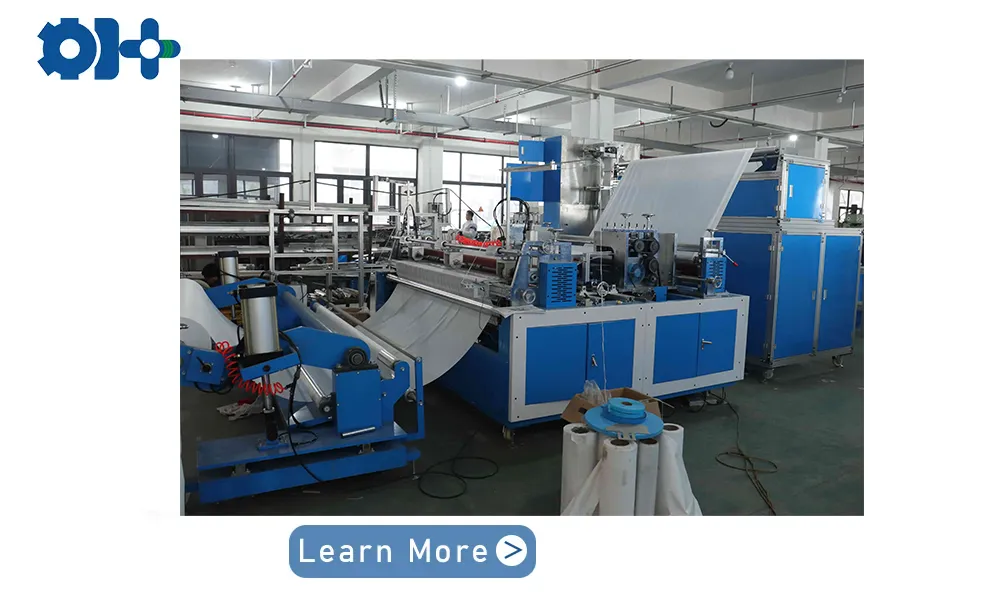
For most buyers, the machine is the first thing they think about. And yes, it is the main part of the initial investment.
A normal surgical drape production line may include:
- material feeding
- cutting and forming
- hole punching if needed
- tape application
- folding unit
If the product is relatively standard, the setup is usually more straightforward.
But once the product has more details, for example different sizes, tape positions, or more precise punching, the configuration changes quickly. This is also why one line may look similar on paper, but the actual cost is not the same.
To be honest, in many projects, the machine price itself is not the hardest part. The more important question is whether the machine really matches the product you want to make.
2. Raw Material Is the Bigger Long-Term Cost
Most surgical drapes are made from SMS nonwoven fabric and laminated material.
This part is often underestimated at the beginning. Buyers focus on machine investment first, which is normal. But once production starts, raw material becomes the bigger long-term cost.
Material cost depends on things like:
- GSM
- fabric width
- supplier source
- product structure
So if you are calculating the total project cost, machine cost is only one part of it.
3. Labor Is Usually Not Very High
For an automatic line, labor is normally not too heavy.
In many cases, 1 to 2 operators are enough to run the line.
Of course, this also depends on how you pack the product and how stable the line is after installation. Some customers start with a few more people in the beginning, then reduce later once the operation becomes smoother.
So labor is part of the cost, but usually not the biggest concern for this kind of project.
4. Workshop Requirement Is Usually Manageable
This type of project does not always need a very large factory space.
In many cases, a workshop of around 100 to 300 square meters is enough for the main production area, depending on the line and layout.
You will also need the basic utility support, such as:
- electricity
- air compressor
- enough space for raw material and finished products
This part depends a lot on local conditions, so it is difficult to use one number for everyone.
5. Output Depends on the Product, Not Only the Machine
A lot of people ask about speed very early. That makes sense. But for surgical drapes, output is not just about the machine speed shown on paper.
A typical line may run around:
20 to 40 pieces per minute
But real output still depends on the product itself. A simpler drape runs easier. A more detailed product with extra functions usually slows things down.
This is something many buyers only notice later. Two lines may both look acceptable in a quotation, but once real production starts, stability matters much more than the nominal speed.
6. What About ROI?
This is usually the real question behind “plant cost”.
People do not only want to know how much the line costs. They want to know whether the investment makes sense.
From what we’ve seen in real projects,
if the line runs steadily, recovering the machine investment within the first year is quite common.
The key is not just the machine price, but whether the production stays stable day after day.
Of course, this depends on:
- your local selling price
- your order volume
- material cost
- production stability
- operator handling
So it is better to think about ROI as a project question, not just a machine question.
7. What Usually Changes the Cost Most
In actual discussion with customers, these are usually the main points that change the investment:
- product size range
- whether hole punch is needed
- tape position and quantity
- folding type
- output target
- automation level
Sometimes the difference looks small when discussing by email. But on the machine side, even a small change in product requirement may lead to a different setup.
That is why giving an exact number too early is often not realistic.
A Practical Example
If you are producing a relatively standard drape, with simple structure and without too many extra functions, the investment is usually more manageable.
If the product includes more details, such as multiple sizes, tape application, or more special structure, the cost goes up accordingly.
So before discussing the final number, it is always better to confirm one thing first:
What kind of drape are you really planning to produce?
A lot of people start by asking for price first.
That is understandable. But for this kind of project, price only makes sense after the product direction becomes clear.
Otherwise, the number may look fast, but it is not very useful.
Need Help Checking Your Project?
If you are planning to start surgical drape production, you do not need to prepare everything perfectly at the beginning.
You can simply share a few basic points, such as:
- product size
- whether hole punch or tape is needed
- expected output
Based on that, we can help suggest:
- a suitable machine setup
- a rough capacity range
- and a practical investment idea based on similar projects
That is usually a better starting point than discussing one fixed number too early.
Here is a machine introduction for you to learn how does the line working: