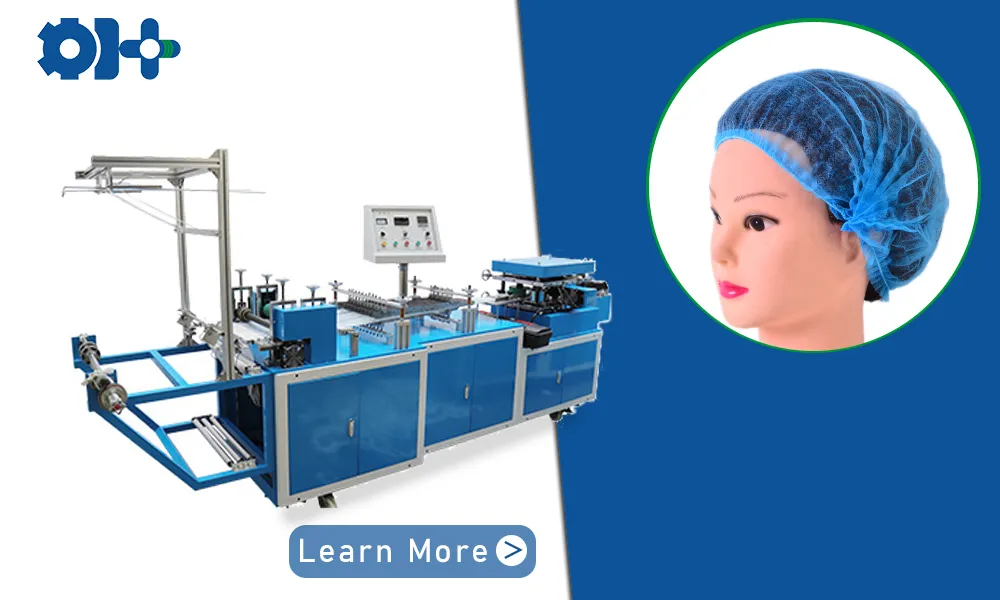
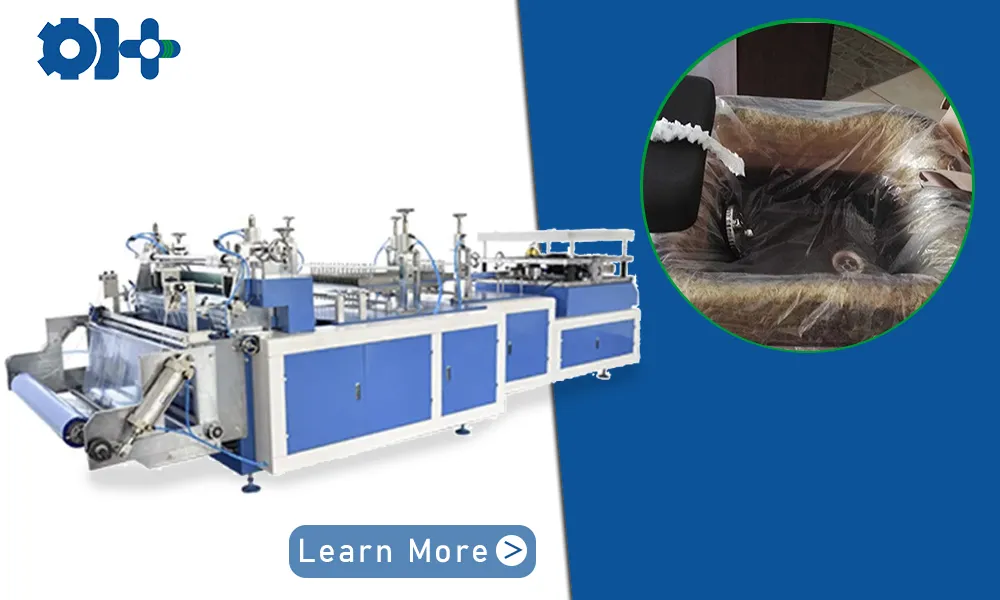
A bouffant cap machine may run fast on paper, but in real production, packing is often the step that slows the whole line down.
That is why, when people ask about machine speed, the real question is usually not only how fast the caps are made, but how smoothly the full line runs from forming to packing.
For a standard bouffant cap making machine, the running speed is usually around:
150–200 pcs/min
This is a common range for standard production. But whether that speed can be maintained through the day depends on more than the machine itself.
1. Machine Speed Is Only Part of the Picture
For this kind of product, speed is easy to write in a quotation.
But actual output is another matter.
In real production, the final result is affected by things like:
- material type
- elastic band or spandex
- feeding stability
- operator handling
- packing method
So even if two machines show the same speed on paper, the real daily output may still be different.
A machine that runs a little slower but stays stable usually gives better total output by the end of the day.
2. Why Packing Often Becomes the Limiting Step
In many cases, the cap forming part is not the problem. The line slows down when finished caps start waiting for packing.
This is where many lines lose efficiency.
If packing is done manually:
- caps begin to accumulate
- more operators are needed
- output becomes less stable
- the machine side may need to stop and wait
So for many projects, the question is not whether the machine can make the caps fast enough.
The real question is whether the finished caps can be counted, handled, and packed without slowing everything down.
3. What a Full Line with Automatic Packing Usually Includes
A bouffant cap line with automatic packing is usually not just one machine.
A more complete setup may include:
- bouffant cap making machine
- elastic feeding system
- counting unit
- automatic packing machine
That means the process can move in one direction:
forming → counting → packing
This is much easier to manage than having operators manually collect and pack the product after the machine.
For customers planning continuous production, this kind of setup usually makes more sense.
4. Packing Method Also Needs to Be Confirmed Early
Packing is not only the last step. It also affects the whole line setup.
Common options include:
- bag packing
- counting and stacking before packing
- box packing, depending on the product and market
Some customers focus on the machine first and leave packing for later. But in actual projects, that often creates problems.
If the cap shape, count per bag, or packing style is not clear early enough, the line may need to be adjusted later.
So it is usually better to confirm the packing direction at the same time as the machine configuration.
5. Real Output Depends on the Whole Process
When people hear 150–200 pcs/min, they often calculate output directly from that number.
But in practice, full-line output is not decided by machine speed alone.
It is affected by:
- whether the material feeds smoothly
- whether the elastic or spandex runs stably
- whether counting is accurate
- whether packing can keep up
- whether the line can keep running without frequent stops
This is why the same speed number can lead to very different production results in different factories.
On paper the speed may look fine. In actual production, what matters is whether the whole process keeps moving.
6. When Automatic Packing Becomes Necessary
Not every customer needs automatic packing from the beginning.
If production volume is still small, manual packing may be acceptable for a while.
But once output goes up, packing usually becomes the first pressure point.
A simple way to look at it is this:
- for lower output, manual packing may still work
- for growing production, packing starts to limit efficiency
- for larger-volume orders, automatic packing becomes much more practical
Many customers do not start with packing automation on day one. But once orders become more stable, they usually come back to this part.
7. Material Still Affects Packing and Output
Even though this page is mainly about machine and packing, material still matters.
For example:
- nonwoven and PE do not behave the same in production
- elastic band and spandex do not feed exactly the same way
- different materials may require different adjustment for stable running
So if the machine setup looks fine but the material handling is not stable, the final output will still be affected.
This is also why machine speed cannot be judged separately from material and packing.
8. What Buyers Usually Need to Confirm First
Before deciding whether you need only the machine or a full line with automatic packing, it helps to confirm a few practical points:
- what material will be used
- elastic band or spandex
- expected output
- packing type
- count per bag or final packing requirement
Once these points are clearer, it becomes much easier to judge what kind of line is actually suitable.
For bouffant cap production, the machine is important, but the machine alone does not decide the final output.
What really matters is whether the full line can run steadily from forming to packing.
That is usually the difference between a line that looks good in a quotation and a line that works well in daily production.
Need Help Checking the Right Setup?
If you already have a target output and a general packing idea, even roughly, that is usually enough to start checking what kind of setup would make sense.
You can share:
- material type
- elastic band or spandex
- expected output
- packing method
Based on that, we can help suggest whether a standalone machine or a bouffant cap making machine with automatic packing would be more suitable for your production.
Related Pages
If you want to see the next step in more detail, you can also check:
Bouffant cap making machine
A typical setup for nonwoven bouffant cap production
Bouffant Cap Machine Running Video with Packing
Shows forming, counting, and automatic packing in real production