Surgical Gown Making Machine Selection Guide
Choose surgical gown making equipment by production stage, gown design and required output. The DEHENG DH-G gown body machine produces 15–25 pieces/minute depending on the garment design. This is the body-making rate, not a guaranteed output for fully assembled and packed gowns.
Match Each Machine to Its Production Stage
| Production stage | Equipment and selection point |
|---|---|
| Gown body | DH-G surgical gown body making machine: 15–25 pcs/min depending on design. |
| Sleeves | Protective gown sleeve making machine: review sleeve design and joining requirements separately. |
| Gown and sleeve joining | Ultrasonic gown and sleeve welding machine: output depends on operator speed and garment design. |
| Folding and packing | Gown folding and packing machine: garments are manually loaded before the downstream process. |
Review the complete surgical gown production solution alongside this guide. Select each stage according to the finished gown rather than assume a body machine completes every assembly and packaging operation.
A surgical gown making machine helps PPE factories produce standard, reinforced, and fully reinforced gowns with better size control, stable panel position, and lower labor cost.
For many factories, the problem is not making one gown.
The real problem is making thousands of gowns with the same quality.
Customers usually care about four things:
- Stable production
- Correct reinforcement panel position
- Easy operation
- Fast delivery for large orders
This guide explains how to choose the right automatic solution for surgical gown production.
Why PPE Factories Need a Surgical Gown Making Machine
Manual or semi-automatic production can work for small orders.
But when the order quantity grows, problems appear quickly.
Common problems include:
| Customer Problem | Production Result |
|---|---|
| Reinforcement panel moves | The protected area is not consistent |
| Glue spraying is unstable | Bonding quality changes |
| Size adjustment is slow | Order changeover takes more time |
| Workers adjust by hand | Quality depends on worker skill |
| Output is low | Delivery time becomes longer |
| Material waste is high | SMS and SMMS cost increases |
A surgical gown making machine helps control these steps by machine settings instead of manual adjustment.
This makes production more stable.
Main Problem in Reinforced Surgical Gown Production
For reinforced surgical gowns, the reinforcement panel is one of the most important parts.
It is usually placed on the chest, sleeves, or other protection areas.
Many factories use hot melt glue to attach the panel. This method can work, but it often creates problems in bulk production.
The glue amount may change.
The panel may shift.
The edge may wrinkle.
The position may not be the same every time.
The production speed is also limited.
This is a common reason why factories upgrade to a full automatic solution.
For reinforced designs, confirm the panel feeding method, position range, bonding process and size adjustment requirements in the proposed equipment specification. These functions depend on the selected configuration.
This helps the factory produce different gown designs with less manual work.
Surgical Gown Standard and Production Control
A surgical gown standard gives the factory a quality target.
It may include barrier performance, seam strength, cleanliness, material quality, labeling, and documentation.
Common standards include ANSI/AAMI PB70 and EN 13795. CDC/NIOSH explains that these standards are used for protective gown classification in healthcare clothing. You can check the reference here: CDC protective clothing standards.
A machine does not replace testing.
But a stable surgical gown making machine helps the factory control the production process before testing.
This is important for buyers who need standard, reinforced, or fully reinforced gowns.
Standard Gown vs Reinforced Gown Machine Solution
Different gown types need different machine configurations.
A standard surgical gown is usually simpler.
A reinforced surgical gown needs extra panel feeding and bonding.
| Item | Standard Surgical Gown | Reinforced Surgical Gown |
|---|---|---|
| Main material | SMS or SMMS | SMS or SMMS with reinforcement panel |
| Panel feeding | Usually not needed | Needed |
| Bonding method | Ultrasonic or sewing | Ultrasonic or hot melt glue |
| Position control | Basic size control | Accurate panel control |
| Changeover | Easier | Needs flexible setting |
| Machine control | Important | Very important |
For reinforced gowns, timing is critical.
Feeding, bonding, welding, cutting, and collection must work together. If one step is not synchronized, the panel may move.
This is why servo control and PLC operation are important.
How Our Automatic Solution Helps Customers
At Deheng, we design the solution based on the customer’s real product.
We do not suggest choosing a machine only by price or speed.
A useful solution should match:
- Gown type
- Size range
- Material
- Reinforcement position
- Bonding method
- Target daily output
- Labor plan
- Standard requirement
Send the standard, reinforced or isolation gown design for a configuration review. The machine specification must match the proposed material, panel layout and production stages. Finished-gown performance requires assessment of the complete product and process.
For reinforced products, the machine can use automatic reinforcement panel feeding. The bonding method can be ultrasonic welding or hot melt glue, based on the product design.
The key point is flexibility.
Customers may need to change gown size, panel size, or panel position. These settings should be easy to adjust.
Why Servo Control and PLC Touch Screen Matter
Customers often ask about speed.
But in real production, stability is more important than short-time high speed.
A full servo control system helps improve feeding accuracy and position control.
A PLC touch screen makes operation easier.
Operators can adjust:
- Gown length
- Cutting position
- Panel position
- Feeding speed
- Welding setting
- Glue setting
- Product recipe
This is useful when the factory produces different orders.
For example, one order may be a standard gown.
The next order may be a reinforced gown.
Another order may be an isolation gown.
With a touch-screen system, changeover is faster and easier.
A surgical gown making machine with simple operation also helps reduce training time for new workers.
Material and Welding Adjustment
Most customers use SMS and SMMS for surgical gowns.
These materials are common because they offer a good balance of protection, comfort, breathability, and cost.
But not all SMS or SMMS materials are the same.
Different suppliers may have different thickness, softness, and surface performance.
So the welding setting should be adjustable.
For ultrasonic welding, the result may be affected by:
- Material thickness
- Material softness
- Welding pressure
- Ultrasonic power
- Production speed
- Welding pattern
For hot melt glue bonding, the result may be affected by:
- Glue amount
- Spray position
- Material tension
- Bonding temperature
- Production speed
This is why technical adjustment is important.
A good surgical gown making machine should allow the operator to adjust settings based on real material.
Daily Output Is More Useful Than Speed Alone
Some customers ask only about pieces per minute.
But for factory planning, daily output is more useful.
Daily output depends on:
- Machine speed
- Working hours
- Number of shifts
- Product type
- Material change time
- Operator skill
- Machine stability
- Packing process
A factory running one shift and a factory running three shifts will have different output.
So before choosing a machine, customers should confirm their daily production target.
For example:
- How many gowns are needed per day?
- How many workers will operate the line?
- How many shifts will run?
- Is the product standard or reinforced?
- Is packing done manually or automatically?
This helps us recommend the right surgical gown making machine configuration.
What Customers Should Prepare Before Quotation
To give a useful proposal, we need to understand the real product.
Customers should prepare:
| Information | Why It Helps |
|---|---|
| Gown sample | Shows the real structure |
| Drawing | Confirms size and shape |
| Size range | Helps design adjustment range |
| Material type | Affects feeding and welding |
| Material weight | Affects tension and bonding |
| Reinforcement position | Decides panel feeding design |
| Cuff type | Affects sleeve process |
| Tie design | Affects fixing process |
| Daily output target | Decides machine configuration |
| Standard requirement | Helps match buyer needs |
| Packing method | Affects production planning |
This is especially important for new investors.
A new factory may not know which machine is suitable. A sample, drawing, material, and output target help reduce wrong investment.
After-Sales Support for Overseas Customers
For overseas customers, after-sales service is a real concern.
Many buyers worry about machine problems and welding adjustment.
These are normal questions.
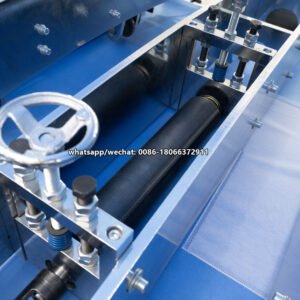
A surgical gown making machine needs technical support, especially when the customer changes material or gown design.
At Deheng, we can provide support based on the project needs.
Support can include:
- Machine installation
- Commissioning
- Operator training
- Welding parameter adjustment
- Troubleshooting
- Spare parts guidance
- Remote technical support
- Overseas technician service when required
For new production lines, training is very useful.
It helps operators learn how to adjust pressure, feeding, welding, glue, and product settings.
This helps the factory start production faster.
How to Choose the Right Surgical Gown Making Machine
The right machine should solve the customer’s real production problem.
Do not choose only by low price.
Do not choose only by high speed.
Do not choose a fixed machine if your orders need many gown sizes.
Before buying, confirm these points:
- What gown type will you produce?
- Do you need reinforcement panels?
- Is the panel on the chest, sleeves, or both?
- Do you want ultrasonic welding or hot melt glue?
- What material will you use?
- What is the gown size range?
- What is your daily output target?
- How many workers will operate the line?
- Do you need overseas installation?
- Do you need operator training?
A good solution should match these answers.
That is the safest way to choose a surgical gown making machine.
FAQ
1. What is a surgical gown making machine?
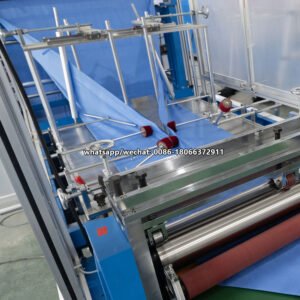
A surgical gown making machine is used to produce disposable surgical gowns from roll materials such as SMS and SMMS. It can help with feeding, forming, bonding, welding, cutting, and collection.
2. Can the machine make reinforced surgical gowns?
Reinforced designs require a separate review of panel feeding, placement and bonding. Confirm the required modules and bonding method for the selected gown sample before ordering.
3. Why does the reinforcement panel move during production?
The panel may move because of unstable glue spraying, poor material tension, manual alignment, or wrong machine timing. Automatic feeding and servo control can reduce this problem.
4. Can one line make different gown sizes?
Yes. A flexible line can adjust gown size and panel position. PLC touch-screen control makes the adjustment easier.
5. What material is commonly used for surgical gowns?
Most customers use SMS and SMMS. These materials are common for disposable surgical gowns because they balance cost, comfort, and protection.
6. Does the machine guarantee AAMI or EN 13795 compliance?
No. Final compliance depends on material, gown design, testing, quality control, and documents. But stable production helps the factory control product consistency.
7. What should I send before asking for a quotation?
Please send the gown sample, drawing, size range, material, material weight, reinforcement position, daily output target, and packing method.
8. Can Deheng provide installation and training?
Yes. We can provide remote support, commissioning guidance, operator training, and overseas technician service when required.
A good surgical gown production line should solve real factory problems.
It should help the factory control size.
It should keep the reinforcement panel in the right position.
It should reduce material waste.
It should make operation easier.
It should support stable daily output.
For factories upgrading from manual or semi-automatic production, a surgical gown making machine can improve production control and reduce labor pressure.
For new investors, the best step is to start with the product.
Send us your gown sample, drawing, material, size range, reinforcement position, and daily output target.
We will help you choose a suitable automatic solution for your factory.
Need a machine for standard, reinforced, or fully reinforced surgical gown production?
Contact Deheng with your product details.
Our team will recommend a suitable surgical gown making machine solution based on your real production needs.
More detail about the machine:
Send Your Gown Sample for Review
Email sales@de-heng.com or dehengmachinery@gmail.com. Phone / WhatsApp: 0086-18066372911. Include the gown sample or drawing, material specification, size range, required stages and target daily output. Equipment voltage can be customized to 380V / 220V according to customer requirements.